
Summary: The increasing problem of childhood obesity, exacerbated by car-centered urban design and by the undergoing revolutionary transition from a play-centered childhood to phone-based childhood can be reduced and solved through explicitly pro-social design. Simple design interventions such as making courtyards flat and drawing lines on the floor are simple first steps.
In the previous post, we saw how very simple design decisions can seriously impact people´s ability to be social and interact with others in pleasant or meaningful ways. For example, we saw that a park designer can either promote or make it impossible for children to play in it via the simple decision of making the surface of the park flat (the flatter the surface of a park or green area, the more pro-social activities, such as playing with balls, are possible). We also saw that a social event organizer can promote or make it impossible for guests to mingle via the simple choice of height chair (the taller the tables and the chairs in a social event, the higher the probability that two people will interact).
In this second post, we will see how designing in a way that deliberately promotes pleasant interactions between people has become crucial to solving urgent social issues such as child obesity, an urgent situation experiencing the North American continent especially and for which I will present a simple intervention.
Case 1: Tackling child obesity through pro-social architectures
The modern combination of bad urbanism, especially the design of cities with a focus on the car, and what some experts call “the transition from a play-based childhood to a phone-based childhood” has created a plethora of severe problems for children, one of which is exploding obesity levels in North America, especially in my home country of Mexico, where more than 75% of children are overweight and 35% are obese.

While it is true that many “neighborhoods” in North America do look like the cyberpunk dystopia above, there are other places that in other times would have been used by children to play, but are no longer. During my childhood for example, which I was lucky to spend in a dense and walkable neighbourhood, I spent countless hours playing with other children in the different courtyards, parking lots and parks available around the block. We would play soccer, dodgeball, and many other games daily. It was very happy childhood.
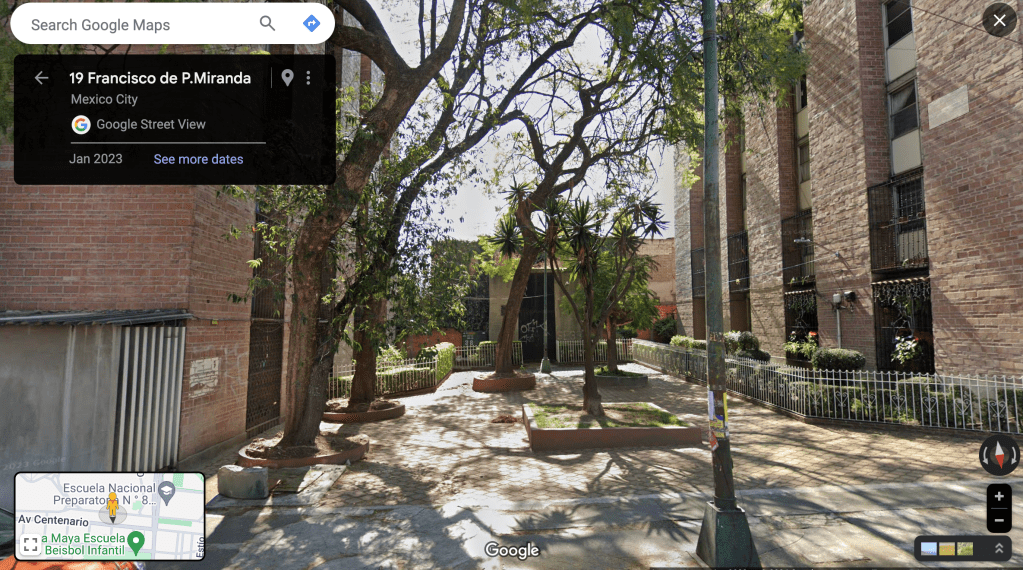
The sweetness of those childhood memories turned somehow bitter when, out of nostalgia, I visited my childhood neighborhood 25 years later. I visited it deliberately in the afternoon, after school, with the hope of running into one of my old neighbors. I checked my childhood´s courtyard (pictured), home of countless hours of play and it was empty, so I walked along the row of buildings and visited all the other places where I used to play as a child.
Even if it was the peak hour for child play, when most of them should have been back from school, all of the courtyards, small parks and parking lots were absolutely and completely empty. No children in sight, anywhere.
Luckily for me I had the chance to get in touch with two childhood friends. We met up and talked about the past. Both of them were pushing 40 and were childless (a trend which is one of the reasons for the lack of children undoubtedly), and when I pointed out that it was strange that our childhood neighbourhood no longer had children they pointed out the obvious:
“Kids don´t play out anymore, they stay inside and play videogames”
Indeed, this conversation is clearly confirmed by statistics and by common sense. There are just too many digital alternatives and children are currently living a revolution that is, in the words of renowned Harvard University psychologist Jonathan Haidt “the transition from a play-based childhood to a phone-based childhood” (more on which on future posts)
There are of course several reasons to be worried about this development, but in this particular article we will tackle one specific problem exacerbated by the “phone-based childhood”, which is the explosion of childhood obesity in my home country of Mexico. Of course, the more time children spend in front of a computer will translate in less time doing physical activity. The statistics leave no doubt and the case was dire even pre-pandemic.

But do not despair because are not diving into all the negative things that are a consequence of childhood obesity. Rather, we´ll jump right to recommending a simple intervention that can dramatically improve the quality of life of children living in a place similar to my childhood courtyard which we will use as an example.-
PROSOCIAL INTERVENTION:
In future posts we will see how some things that used to be obvious in the past now might need to be incentivized with pro-social design in mind (What used to be obvious no longer is). Sure, in the past it was obvious that children would play pretty much play in any place, but such obvious thing no longer is. We now need to PUSH children to play in a way that is irresistible
Let´s take a look at a possible pro-social intervention that would PUSH children around my childhood courtyard to get together and play in a way that is difficult to resist.
A simple pro-social intervention that would incentivize children would be to add a signifier indicating that the courtyard allows and even promotes play, for example, via the addition of floor markings indicating the possibility of games such as hopscotch and its variations. Of course, a less simple and more expensive variation could be the installation of a playground.


To reach teenagers, the most audacious pro-social designers could integrate a small soccer or basketball court It might sound like overkill but remember that if we want to solve problems such as childhood obesity we must also remember that What Used to be Obvious (children play) No Longer Is, so pro social behaviors now need to be actively incentivized.
In a nutshell, we need to incentivize children´s physical play with very obvious signifiers that allow them to play.
I temporarily lived in a Polish commie block. Despite all it´s flaws, the blocks had direct access to basketball and soccer courts as well as public ping pong tables. Surely, I did see plenty of children there, who would have probably otherwise been locked up in their own rooms playing videogames.

Cultural factors such as attitude towards food might also play a role, but certainly the easy availability of sports in Poland might play a role in it being a country with relatively low child and teenage obesity despite their penchant for fast food.
In a nutshell, to tackle childhood obesity it is crucial to create architectures that make it as easy and obvious as possible for children to play.
 Rodrigo Serrano